I handed Seth a debit card linked to my checking account the week after he proposed to me, 7 years into our relationship. It was a big step for both of us because up until that point, all of our money had been separate. We paid for bills together, but our accounts were separate because we weren’t sure if this was a forever relationship. Who ever really is? But a proposal was at least a verbally binding commitment.
Linking our financial life was important to me because it meant that we trusted each other fully. But also as the primary income earner at that time while Seth was in school, I wanted him to have access to money without asking me for it.

Seth and I shortly after our engagement
From there, we slowly closed our personal accounts and opened new joint checking, savings, and investment accounts, which leads us to where we are now: completely combined except for Seth’s employer-sponsored investments and my individual 401k for my business. And we both have access to all accounts via our shared 1Password app and Monarch.
This arrangement is not for everyone, though.
And it has not been without its challenges. So in this article, I’m going to talk about some of the ways you could manage your finances as a couple and their pros and cons.
I’ll discuss:
having almost all joint accounts
completely separate accounts
and a hybrid where you share one account for fixed costs
Data on Shared vs. Separate Accounts
First, some statistics about married couples, according to this article from the U.S. Census for 2023:
23% of couples had NO shared accounts in 2023, which was up from 15% in 1996
77% of couples held at least one joint account, down from 85% in 1996
40% of couples held ALL of their accounts jointly, down from 53% in 1996
17% had both joint and separate accounts, up from 9% in 1996
This same article from the Census gives some hypotheses for why things have changed, including marrying later in life when people’s accounts are more established. People may also start combining accounts after having children, and they showed that the longer people were married, the more likely they were to have joint accounts.
And joint accounts were far more common among married couples than unmarried couples who live together. Only 16% of cohabiting couples had a joint account (25% if they had kids at home), compared to 77% of married couples.
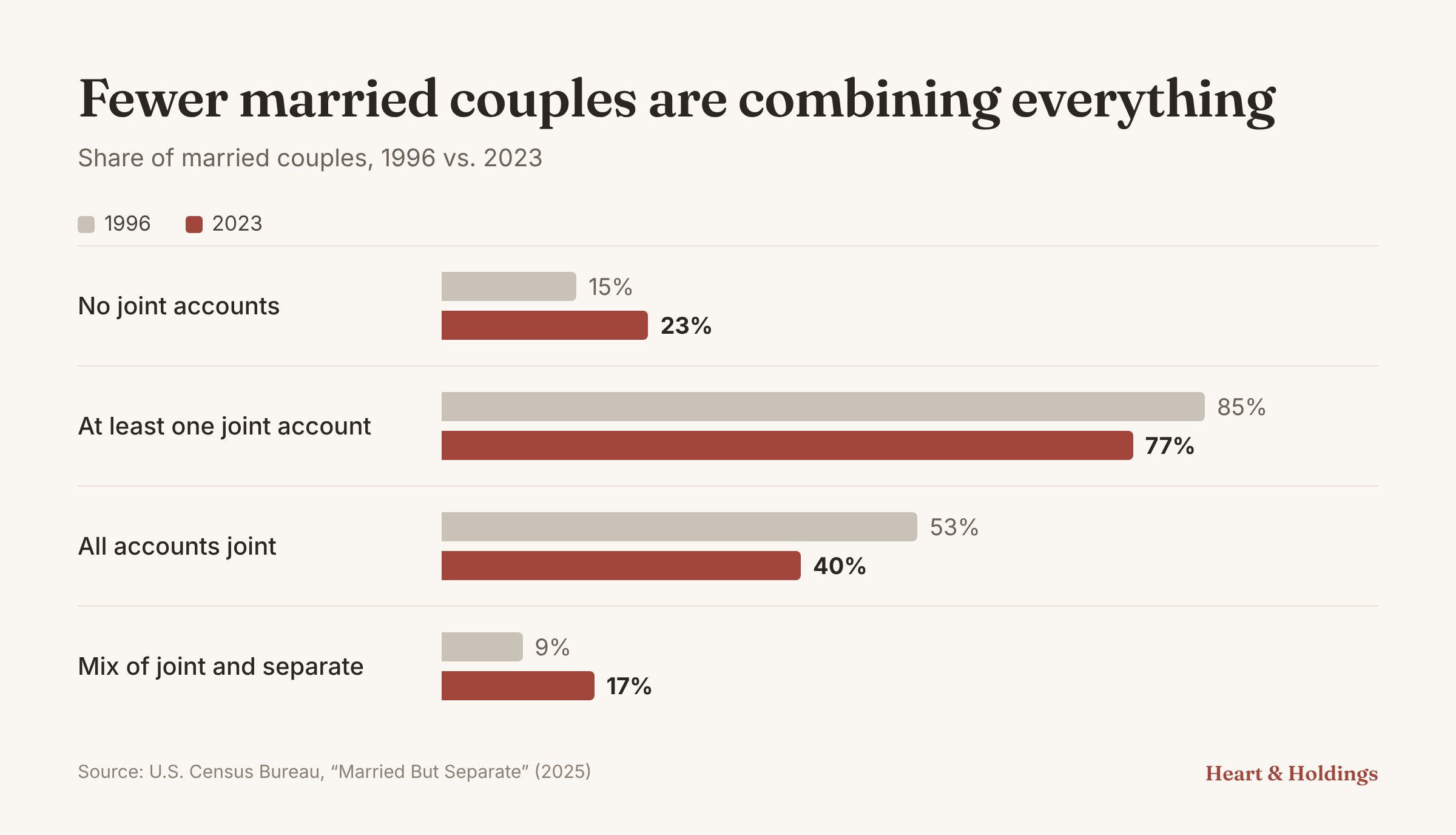
So in the U.S., at least, we’re trending more toward having some separate accounts, but most people have at least one joint account.
1. Mostly Joint Finances
I’ll start with the way we do it: the mostly joint finances category, and the pros and cons. You can get more details on our situation in a recent article here, too. When we first started sharing money, it was with that one debit card, which was the only account I actually had besides a savings account.
Seth had his own checking, savings, credit card, and investment accounts at different institutions. We continued opening checking, savings, investment, and eventually credit card accounts jointly and both of us had the logins and passwords, so we could check in on everything whenever we wanted.
All of our paychecks went into the same checking accounts, we paid our credit cards off every month from that checking account, and we paid for all of our bills on either the checking or the credit card.
Every month a few days before our credit cards come due, Seth checks in with our checking account to make sure that we have enough to pay “the credit cards off. We have intended budgets for all aspects of our spending, and we’ve been tracking our spending for years, so we know about how much we need every month to cover it all. We did not always know these numbers and used to take money out of savings way too often to cover our costs. Now we know how much of a buffer we need to keep in checking to make sure we’re all good.
We use Monarch, a money app, where we have entered all of our accounts and debts, including our mortgage, all credit cards, all checking and savings, Venmo, and all investments.
The Cons of Mostly Joint Accounts
Here’s where it gets tricky when everything is combined.
The Money Person Carrying It All
Sometimes one person is the “money person” in the relationship, so they take care of all the bills, the moving of the money, and the stressing over the money. The other person may technically have access to the accounts, but they are mostly doing the spending and not the worrying. Sometimes there’s even a parent-child dynamic going on where the non-money person asks their partner for things and the partner has to say no, as if they are a parent. Or they have to say yes for fear of disappointing their partner, even though they know they don’t have the money for it.
For the record, this is not good for one’s sex life.
Lack of a Plan
In our case, even though we both have always had access to our accounts, we’ve both looked at our accounts regularly, and even talked about things, we both still used to have a lot of resentment. I would spend a generous amount on clothes, gifts, jewelry, or going out to eat with my friends. He would spend a generous amount on woodworking tools, and well, woodworking tools I guess.
And then we were both looking at our accounts kind of in our heads like, ‘Wait why’d you spend so much on that thing?’ But we didn’t really say it out loud. And then we didn’t have as much savings as we would’ve liked and we were always wondering where all of our money was going. I usually felt guilty for all the things I bought, even though I bought them anyway. And same for him. We both felt pretty out of control and resentful and it would come out in weird, passive aggressive ways.
We had joint accounts, but we were not on the same page, and that is a problem.
We had no shared vision of what we wanted our future to be like, so we didn’t know if we were “on track” or if our spending was completely insane. We just had strong feelings about things costing “too much” or not having “enough in savings,” even though we didn’t know what the numbers should look like. We had no plan. Fortunately, we finally created a shared vision for our lives, which allowed us to work together and stop spending mindlessly.
Feeling Less Drive to Earn
Another con that I will admit for myself is that I used to have really lofty financial goals for myself personally when we had mostly separate accounts, and I used to hustle really hard to achieve those goals. When Seth started making very good money and our accounts started growing more than I could ever have imagined, my drive to earn definitely diminished. I felt like I had less skin in the game because things were so comfortable, which led to a lack of meaning and purpose in my life.
Pros of Joint Accounts
Transparency
One pro of this system is that there is transparency for everything. You can’t commit financial infidelity if everything you spend is visible to your partner. You are held accountable by your shared banking dashboards. Not that I’m trying to have couples police each other, but accountability can be healthy when you’re working together as a team.
Shared Vision
Joint accounts can also be a great vehicle for a shared vision of the future. If, for instance, you have a goal of going to Tahiti and staying in an overwater bungalow for a week (speaking for a friend), or buying a house, or retiring by the age of 55, it’s way easier to be on the same page with your partner about these goals if you are literally looking at the same page.
Connecting
For me, it also feels very connecting. I feel like Seth and I are a team and we’re in this together, even though we make very different incomes. We celebrate milestones together and we are invested in making our plan work, so we brainstorm and forecast things out as partners. But you don’t have to have access to each other’s accounts in order to do that (see below).
2. Completely Separate Accounts
This one is what Seth and I did for the first 7 years of our relationship, and while it can work for some people, it can get pretty tricky. The thing about all of these pros and cons is that they almost all are about communication - not money. Keep an eye out for that as you read.
I’ll start with the cons.
Cons of Completely Separate Accounts
Lack of Connection
Here’s my first thought: since money is such a huge part of everyone’s lives, if you’re not connecting about it, it’s kind of a wasted opportunity to know your partner even more intimately. I have a friend who’s been with her boyfriend for about 8 years and she recently told me that they just had their first open conversation about each other’s financial situations.
The thing about all of these pros and cons is that they almost all are about communication - not money. Keep an eout for that as you read.
I was really surprised, honestly. Until that point, they didn’t know how much money each other made, how much they had saved, or how much debt they had. Perhaps money is not a stressor for either of them, but according to this survey, “83% of Americans - roughly 216 million people - report experiencing financial stress, strain, or uncertainty.” So if this couple is like most Americans who are experiencing stress about money and they’re not comfortable openly talking about it with each other, that sounds lonely to me.
Different Incomes and Unbalanced Expectations
The other concern with completely separate accounts is that people don’t always make the same amount of money throughout their lives, so the couple needs to make adjustments to each partner’s spending expectations as things change. And that can get complicated. Maybe one partner has taken on all things “kid expenses,” but as the kids get older, things get way more expensive and that partner can no longer carry the burden with their income without feeling extremely stressed out. There are many examples like this where things can get muddy.
Savings and Retirement
When you can’t see your partner’s accounts and you don’t know anything about them, it’s difficult to work together on any savings or retirement goals. And especially if you have shared assets like children, a house, or cars, you might be very interested in your partner’s financial solvency. This can obviously be overcome by open communication, as can most of the cons in this list.
Venmo-ing
When you do things separately, you’re typically paying each other back for things constantly, and that can be hard to keep track of. Groceries, rent, utilities, etc. can get tedious, and if someone takes too long to pay the other back, or if there aren’t very clear expectations about who is buying what, resentment can build.
Benefits of Completely Separate Accounts
Achieving Personal Goals Is Fun
Achievement-oriented people who have really clear financial goals for themselves might really enjoy completely separate accounts. Watching your accounts grow (or your debts shrink) and knowing that YOU DID THAT without anyone’s help can be extremely satisfying. Just paying your own bills and knowing you did it on your own can be hugely important for some people’s self-worth.
Trust Issues
Another benefit is that if one person really does not trust the other partner with money, and they don’t want to expend the effort policing them with joint accounts, keeping things separate is a valid solution, especially if there has been financial infidelity before and trust is still being rebuilt.
Autonomy
Another benefit is simply autonomy. Some people just don’t like the idea of anyone having anything to do with their money, and that is perfectly fine if it works for the relationship and communication is clear.
3. One Shared Account
There are many ways to do a hybrid between separate and joint accounts, and a common one is having one shared checking account where both partners contribute a certain amount each month to cover fixed costs and the rest stays in their personal accounts. This means that there is an agreed upon amount that each person needs to contribute, whether that is 50/50 or some other arrangement.
A hybrid of this hybrid might even be to have a shared money app account where all accounts from each partner are synced, but each partner retains control (i.e. password and spending authority) over their private accounts. This way, if they have shared retirement or savings goals, they’re easy to track and communicate about. You could also do this with the Completely Separate Accounts method to maintain openness and work toward shared goals more easily.
Pros of One Shared Account
Many of the pros here are the same as the pros in the Completely Separate Accounts category above: autonomy, self-worth from achieved goals, trust issues resolved, etc.
Connection and Accountability
The one main benefit to having one shared account, besides the above is, that there is some connection, accountability, and transparency about money, and people don’t need to Venmo each other back and forth constantly. The shared money is automatically transferred out of your personal accounts and all shared bills are taken care of - no resentment there.
Then everyone can do whatever they want with their own money, as long as it aligns with their shared goals, if they have any.
Cons of One Shared Account
Unfair Contributions
One thing to make sure you do well and often is communicate about how much each person is contributing. For instance, if one person makes $50k per year and the other person makes $150k per year, should they really be doing 50/50 on their fixed costs? I don’t think so. I think that would be extremely stressful for the lower earner and unfairly advantaged for the higher earner.
It could easily be distributed proportionally, so if all of the utility bills, groceries, mortgage/rent, and everything else shared came out to $4k per month, the person making $50k per year would put in 25% of $4k ($1,000) and the person making $150k would put in 75% ($3,000). Another option would be to have each person retain the same amount of extra money in their personal accounts after their contributions to a shared account.
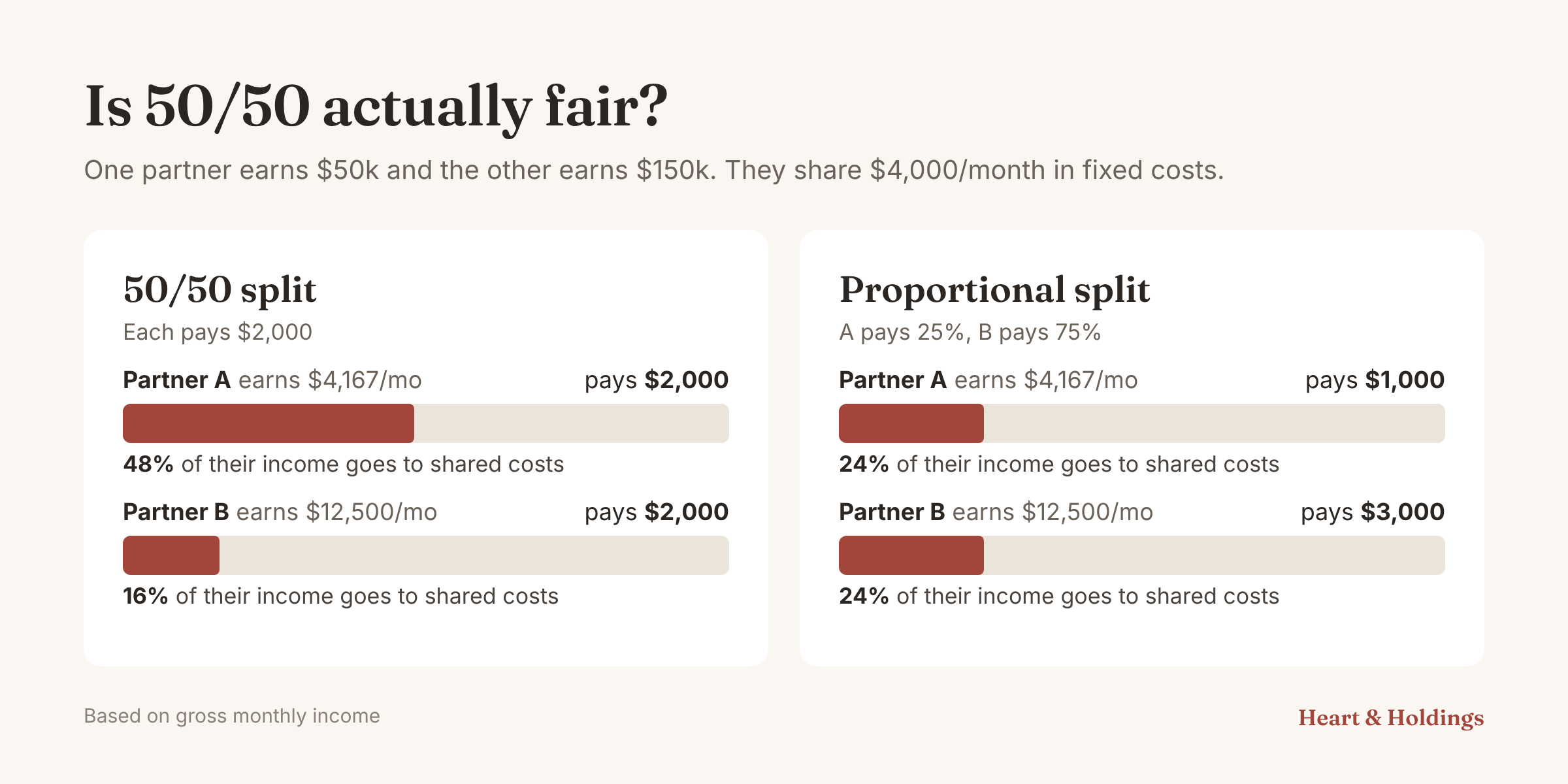
These can be hard pills for some people to swallow, and not every couple will decide to do them. But they are options that we often don’t consider in our 50/50 culture.
In Conclusion…
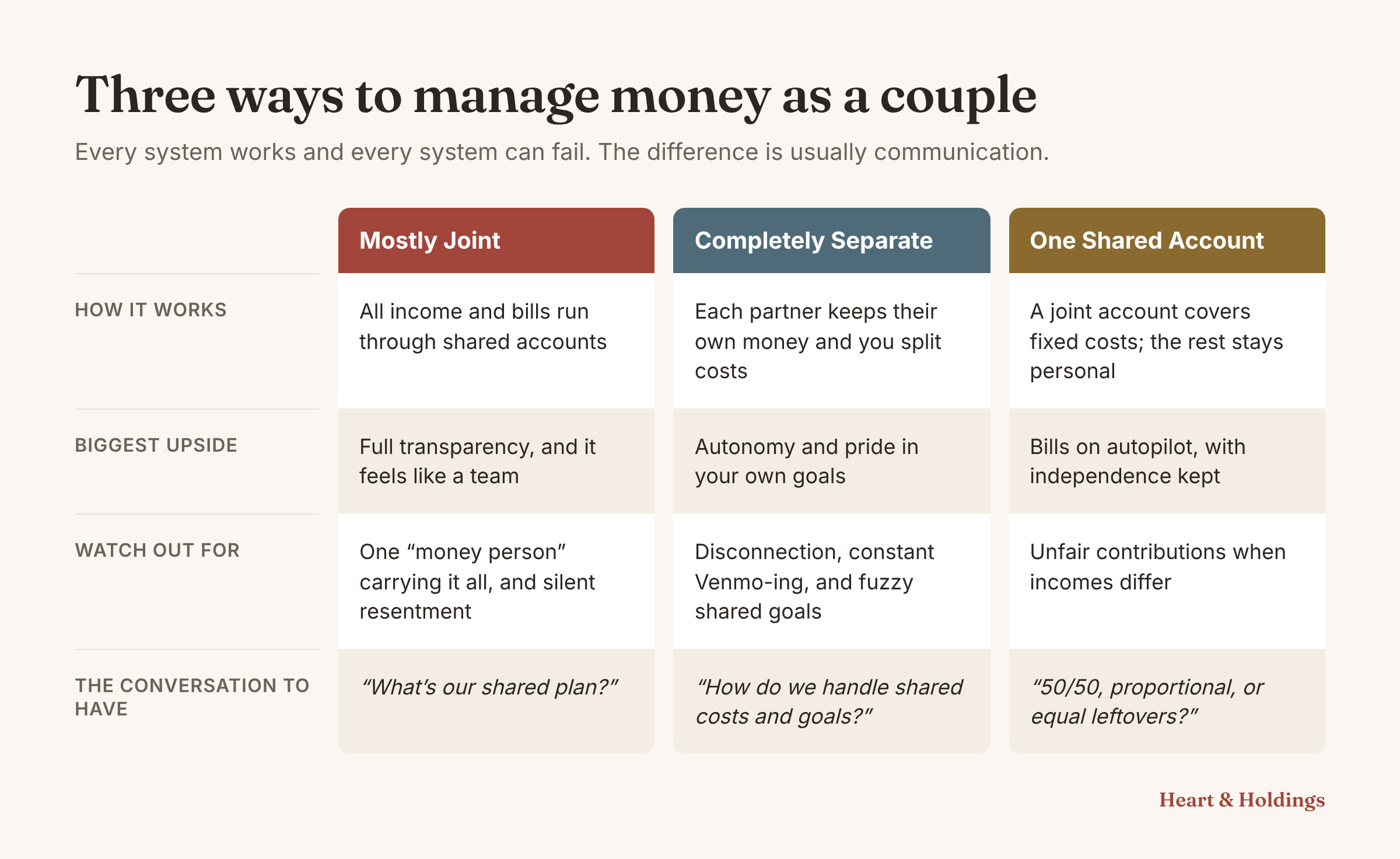
So that is my rough assessment of three of the strategies for managing finances as a couple. There are so many considerations for each of these strategies, and each one of them could be an entire article on its own! But I do hope this gives you some things to think about, and perhaps makes for a good conversation starter with your partner if you’re having some feelings about how you two are managing your own finances.
3 Questions for You
Here are three questions to ask yourself right now if you’re not feeling satisfied with how you manage your finances as a couple:
What do you not like about the current financial system in your relationship?
What would you prefer to do instead?
How is communication (or lack thereof) contributing to your dissatisfaction?
On that note, I have a free guide on how to ask for what you want without starting a fight, and this might be the perfect time to use it. Get The No-Fight Script here.
If you're in Texas and money keeps coming between you, I offer $30 online couples therapy and individual therapy.
Talk soon,
Neely